
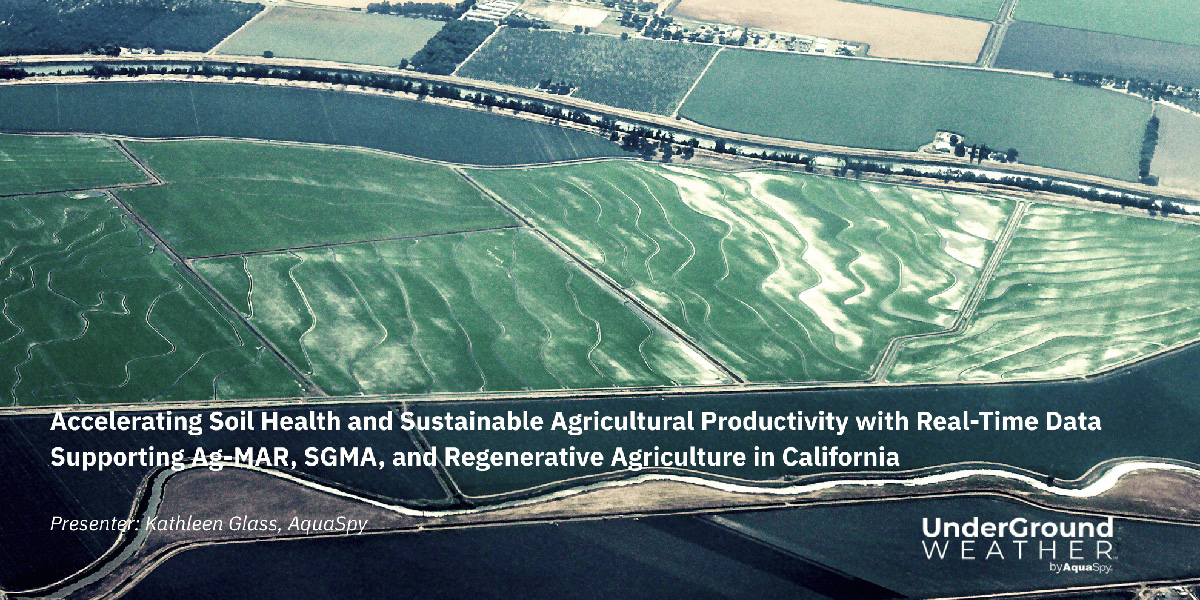
Accelerating Soil Health and Sustainable Agricultural Productivity with Real-Time Subsurface Data
Making Ag-MAR and SGMA Work at Field Scale
California agriculture is being asked to do something unprecedented:
- Recharge groundwater at scale
- Protect groundwater quality
- Maintain productivity in high-value perennial systems
- Demonstrate measurable regenerative outcomes
Programs like Agricultural Managed Aquifer Recharge (Ag-MAR) offer real promise. Capturing flood flows and spreading them across agricultural lands can stabilize aquifers and build drought resilience.
But recharge introduces a fundamental tension:
Water moves downward — and so does whatever is dissolved in it.
The success of recharge is not determined solely by how much water is applied. It depends on what is already present in the soil profile when that water arrives.
The Overlap Between Ag-MAR, SGMA, and Regenerative Agriculture
Under the Sustainable Groundwater Management Act (SGMA), basins must reach sustainability — not just in quantity, but in quality.
At the same time, California’s regenerative agriculture framework emphasizes:
- Improved soil function
- Reduced nutrient losses
- Enhanced water quality
- Long-term resilience
Ag-MAR, SGMA, and regenerative agriculture are often discussed separately. In reality, they converge at one critical control point:
Nitrogen management in the soil profile.
Why Nitrogen Is the Central Risk During Recharge
Research examining recharge and related water management practices consistently identifies one dominant predictor of nitrate leaching:
Residual soil nitrate before flooding.
Recharge events move large volumes of water through the vadose zone. If nitrate is present, it is highly mobile and readily transported below the root zone.
Recharge does not create nitrogen risk — it mobilizes existing nitrogen.
This shifts the management focus from surface inputs to subsurface conditions.
What Research Tells Us About Reducing Nitrate Leaching
Studies of Ag-MAR systems highlight several practices that reduce nitrogen loss:
Start with Low Residual Nitrate
Fields with low pre-flood nitrate levels consistently exhibit reduced leaching.
Favor Continuous Over Intermittent Flooding
Intermittent flooding allows oxygen to re-enter the soil between events, promoting nitrification and increasing nitrate availability. Continuous flooding maintains anaerobic conditions, supporting denitrification and reducing mobility.
Use Non-Leguminous Cover Crops
Cover crops scavenge residual nitrate during the wet season, decreasing the pool available for leaching.
Time Fertility Strategically
Separating nitrogen applications from recharge windows reduces the risk of mobilizing freshly applied nutrients.
These strategies are well supported in research.
The challenge is operational.
The Monitoring Gap
Most nitrogen management still relies on:
- Periodic soil sampling
- Historical fertilizer assumptions
- Monitoring wells that detect impacts long after they occur
Recharge events, however, are dynamic and often compressed into narrow windows. Conditions in the soil profile can change rapidly — particularly during flooding.
Episodic measurements cannot fully capture:
- When nitrate concentrations increase
- When soils transition from aerobic to anaerobic
- When denitrification becomes active
- When nitrate begins moving below the root zone
By the time nitrate appears in a monitoring well, the management opportunity has passed.
The Role of Subsurface Process Visibility
Advances in in-field instrumentation now allow continuous measurement throughout the soil profile — from the active root zone down into the vadose zone.
Instead of sampling at a single depth on a single day, it is now possible to observe:
- Soil moisture dynamics across multiple depths
- Nitrate availability as it changes
- Redox potential, indicating biological conditions
- Temperature and salinity interactions
This transforms nitrogen management from inference to observation.
For recharge systems, this visibility allows operators to:
- Verify low residual nitrate prior to flooding
- Observe nitrate movement during recharge events
- Confirm anaerobic conditions that support denitrification
- Track how salts respond under prolonged saturation
In short, recharge becomes a managed process rather than a hydraulic assumption.
Why Redox Matters in Ag-MAR
Redox potential is rarely discussed outside soil science circles, yet it is fundamental to recharge outcomes.
Redox conditions determine whether nitrogen:
- Remains in nitrate form
- Is converted via microbial denitrification
- Accumulates under oxygenated conditions
Continuous flooding can promote denitrification — but only if anaerobic conditions are sustained.
Without measuring redox, managers cannot confirm whether biological processes are mitigating nitrate risk or whether soils are cycling back to oxygenated conditions between events.
Recharge success is not purely about infiltration rates.
It is about biological transformation within the soil matrix.
Specialty Crops and Recharge Integration
Perennial systems such as almonds and wine grapes require particular care:
- Deep, long-lived root systems
- Significant nitrogen investment
- Sensitivity to salinity
- High economic value per acre
In these systems, recharge must align with fertility programs and root zone dynamics.
When subsurface conditions are visible, recharge can be coordinated with:
- Nitrogen drawdown
- Cover crop uptake
- Soil biological activity
- Salt redistribution
This alignment reduces unintended nutrient export while supporting soil function.
What This Means for Water Districts and GSAs
For groundwater sustainability agencies and water districts, recharge programs must withstand scrutiny.
Field-scale subsurface data provides:
- Evidence of low nitrate risk prior to flooding
- Verification of biological denitrification during recharge
- Early warning of unintended nitrate movement
- Greater confidence in Ag-MAR site selection
This shifts groundwater quality protection from reactive monitoring to proactive management.
From Compliance to Continuous Improvement
Historically, groundwater protection has been reactive — responding to exceedances after they occur.
Recharge under SGMA requires a higher standard.
When the soil profile is continuously monitored, nitrogen management becomes adaptive:
- Fertility timing can be adjusted in real time
- Recharge windows can be evaluated based on subsurface conditions
- Biological processes can be confirmed rather than assumed
- Regenerative claims can be substantiated with data
This is not simply a technological upgrade.
It represents a shift in mindset:
The soil profile is a managed system, not a black box.
The Next Frontier in Regenerative Agriculture
Ag-MAR, SGMA, and regenerative agriculture share a common objective:
Sustain productivity while protecting groundwater.
Achieving that objective requires more than good intentions and surface metrics. It requires visibility into the processes that determine whether nitrogen moves, transforms, or remains in place.
Continuous subsurface measurement provides that visibility.
And when below-ground processes are visible, recharge can become not only a water solution — but a soil health solution as well.
Listen to the recent Flood-Mar webinar here. https://youtu.be/R7FXq76Ryv0